

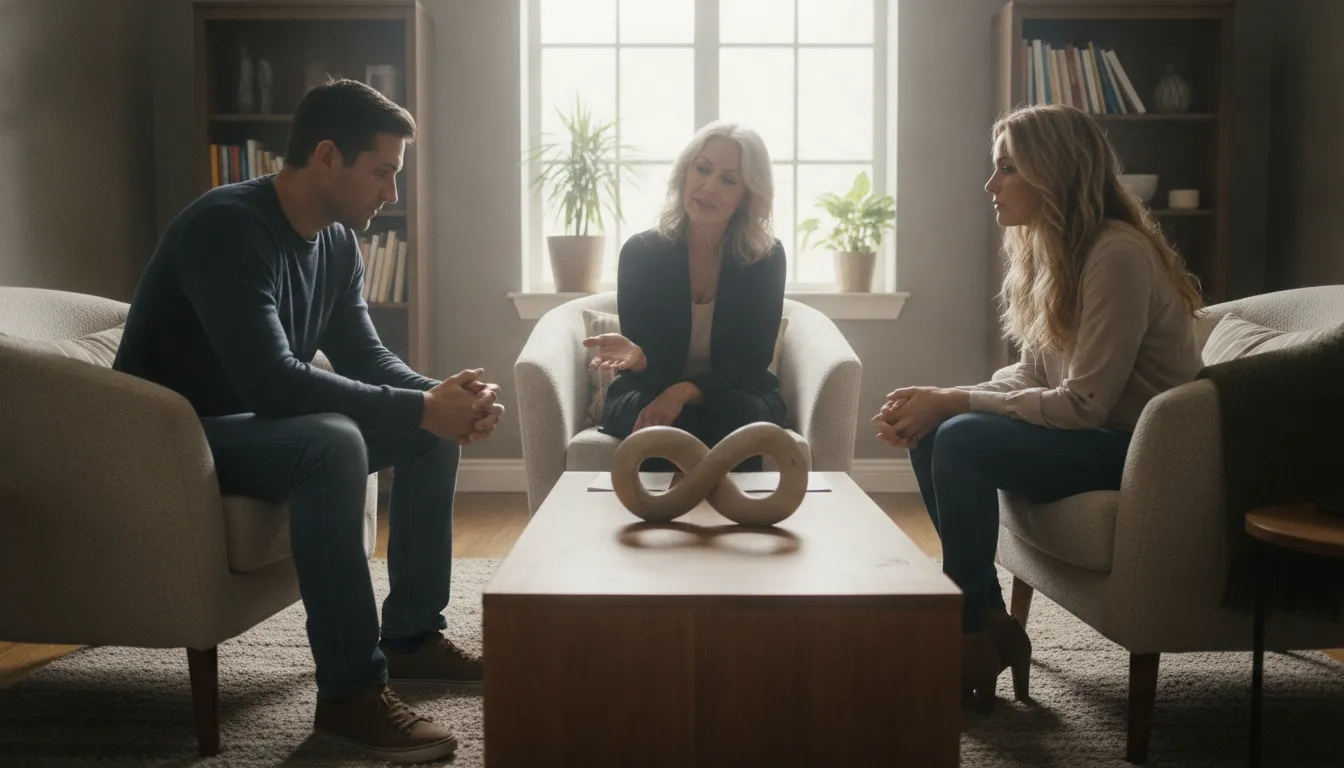
Sometimes closeness feels less like connection and more like losing track of where you end and another person begins. You may notice that your partner's mood determines your own, that independent choices trigger guilt. Or that your needs seem difficult to identify without first considering someone else's reaction.
An enmeshed relationship is marked by blurred emotional boundaries, where partners may experience one another's moods, thoughts, needs, and desires as inseparable. Healthy intimacy allows deep connection while preserving each person's identity, beliefs, emotions, and ability to make independent decisions.
These patterns are not evidence that anyone is weak or uncaring. They often develop as adaptations within a family system and can continue long after they stop supporting the people involved. Understanding the difference between loving closeness and emotional over-involvement is the first step toward greater autonomy without sacrificing connection. Family Systems Theory and Internal Family Systems therapy offer practical ways to understand these dynamics, strengthen differentiation, and build relationships that feel both secure and spacious.
What Is an Enmeshed Relationship?
An enmeshed relationship is marked by emotional over-involvement and too little separation between two people. Moods, thoughts, needs, and desires can become so intertwined that one person struggles to identify what they genuinely feel or want apart from the other person. The connection may feel deeply loving, loyal, or protective, yet it can gradually make ordinary independence feel threatening.
Enmeshment is not simply closeness, frequent communication, or a strong desire to support a partner. In a healthy relationship, two people can remain connected while also holding different opinions, interests, friendships, and emotional experiences. In an enmeshed relationship, one person's distress may immediately become the other person's responsibility, and disagreement may feel like rejection or betrayal.
This pattern often develops within a family system rather than beginning with one isolated choice. A child may learn to monitor a parent's emotions, take on a caretaker role, or suppress personal needs to preserve harmony. Those adaptations can make sense in childhood. Later, they may appear in adult partnerships as difficulty setting boundaries, making independent decisions, or tolerating a loved one's disappointment.
Enmeshment and differentiation
Bowen Family Systems Theory describes differentiation of self as the ability to maintain your own beliefs and emotions while staying emotionally connected to important people. Differentiation is not detachment. It means you can listen to someone else's perspective without automatically absorbing it, and you can make a thoughtful decision without needing complete agreement.
From this perspective, the goal is not to care less. It is to become more grounded within the relationship. A differentiated partner can say, "I understand that this is difficult for you. And I still need to make the decision that is right for me." That stance creates room for honesty, responsibility, and mutual respect.
Research has associated enmeshment patterns with functional impairment, anxiety, depression, and lower relationship satisfaction. These findings do not mean that every close family or couple relationship is unhealthy, nor do they predict an individual's outcome. They do suggest that persistent difficulty separating your emotional experience from someone else's deserves compassionate attention.
Family Systems and IFS therapy can offer useful language for understanding these patterns. Internal Family Systems work may help a person notice the protective parts that fear separation, guilt, or conflict without treating those parts as defects. With greater awareness, it becomes possible to honor the relationship while developing a clearer sense of self.
Enmeshment vs Healthy Closeness: Finding the Balance
Closeness is not the problem. A strong relationship can include deep emotional intimacy, shared routines, and a genuine desire to support one another. The difference is whether each person can remain a separate individual inside that connection. In an enmeshed relationship, emotional boundaries become so blurred that one person's mood, needs, or choices can feel like a demand on the other person. Healthy closeness leaves room for connection and autonomy at the same time.
What feels like intense love in childhood may become suffocating in adulthood. A child may adapt by monitoring a parent's emotions, prioritizing family needs, or treating agreement as proof of loyalty. Those strategies can make sense in the original environment. Yet become restrictive later when the person needs to make independent decisions, develop adult relationships, or express a different point of view.
| Area | Enmeshment | Healthy closeness |
|---|---|---|
| Emotional connection | One person's feelings quickly become everyone's responsibility. Distance or disagreement may feel threatening. | Partners notice and respond to each other's emotions without assuming they must eliminate every uncomfortable feeling. |
| Boundaries | Privacy, personal time, and limits may be interpreted as rejection, selfishness, or disloyalty. | Each person can set reasonable limits while preserving respect, affection, and reliability. |
| Decision-making | Choices are shaped primarily by fear of upsetting someone or losing approval. | Partners consult one another, then take responsibility for their own values and decisions. |
| Identity | It can be difficult to distinguish personal beliefs, needs, and desires from those of the relationship or family. | Shared identity and individual identity develop together. Similarity is welcome, but difference is safe. |
| Conflict | Disagreement may trigger guilt, withdrawal, pressure to conform, or an urgent effort to restore harmony. | Conflict is addressed directly. Repair does not require either person to erase their perspective. |
People in enmeshed dynamics are often told, or tell themselves, that they are too much, too needy, or too dependent. That self-judgment can obscure the more useful question: have you had enough freedom to know what you feel and want? The goal is not emotional distance or rigid independence. It is differentiation, the ability to hold your own beliefs and emotions even when someone you love wants you to think or feel differently.
Building that balance takes intention. Relationships don't just happen. They are built through honest conversations, respectful boundaries, and repeated choices that protect both connection and individuality.
How Enmeshment Affects Identity and Autonomy
When a family system is enmeshed, closeness can come at the cost of knowing where one person ends and another begins. A child may learn to monitor a parent's mood, anticipate a sibling's needs, or make choices based on what will preserve emotional stability at home. Those adaptations can be understandable and even necessary in childhood. In adulthood, however, they may make independent decision-making feel disloyal, unsafe, or simply unfamiliar.
When your own preferences become difficult to hear
Enmeshment can interfere with the development of a clear, confident sense of self. Instead of asking, "What do I want?" a person may automatically ask, "What will keep everyone happy?" or "Who will be upset if I choose this?" Over time. Preferences can become muted beneath responsibility, guilt, or the expectation that family members should share the same opinions and priorities.
This does not mean that someone who grew up enmeshed lacks a personality or does not love their family. It means their identity may have developed in close response to other people's emotions. Generational boundaries can become blurred, particularly during the transition into young adulthood, when a person is naturally expected to form independent values, relationships, and goals. Leaving home, choosing a career, setting a boundary, or building a partnership may then feel like abandoning the people who shaped them.
The emotional cost of losing autonomy
Autonomy is not emotional distance. It is the ability to remain connected while recognizing that your thoughts, feelings, needs, and decisions belong to you. In an enmeshed relationship, that separation may feel threatening. A person might seek repeated reassurance before making ordinary choices, defer to a partner or parent, or experience intense guilt after expressing a different view.
These patterns can also affect emotional well-being. Research on enmeshment schemas has associated difficulty differentiating from family with functional impairment, anxiety, depressive symptoms, and lower relationship satisfaction. Social anxiety may further connect enmeshment with reduced quality of life, including challenges involving personal growth, social functioning, and achievement. These findings do not predict one person's experience, but they help explain why autonomy struggles can reach beyond a single family interaction.
It is common to interpret these difficulties as being "too needy," "too sensitive," or incapable of making decisions. A more compassionate view is that the person learned connection through self-abandonment. Rebuilding autonomy begins with small acts of noticing: identifying a genuine preference, tolerating another person's disappointment, and remembering that disagreement does not automatically mean rejection. Healthy closeness allows love and loyalty without requiring the loss of an individual self.
What Causes Enmeshment and How It Develops
Enmeshment usually develops gradually within relationships and families, rather than appearing because one person made a single wrong choice. In many cases, the pattern begins in a family where emotional closeness is essential for belonging or safety, but personal boundaries are not clearly recognized. A child may learn to monitor a parent's mood, anticipate needs, or set aside personal feelings in order to keep the household calm. Those adaptations can be intelligent and protective at the time, even if they later make independence feel threatening.
Family-of-origin patterns
Family roles often shape what each person believes love requires. A child may become the confidant, mediator, caretaker, or emotional anchor for a parent. Another child may feel responsible for protecting a sibling or preserving family unity. When these roles are treated as fixed obligations, ordinary development can become confused with disloyalty. Saying no, choosing a different path, or keeping something private may feel like abandonment rather than a normal expression of growing autonomy.
These patterns can also move across generations. A parent who grew up with blurred boundaries may have learned that constant involvement is proof of devotion. A family that has experienced instability, loss, addiction, discrimination, or other chronic stress may rely heavily on togetherness to survive. Without reflection, that strategy can be passed forward. What once helped a family remain connected may become restrictive when children mature and need more room to form separate identities.
When childhood adaptations continue into adulthood
Childhood survival adaptations do not mean a person is damaged or incapable of change. They may simply remain active after the original danger has passed. An adult who learned to prevent conflict by agreeing quickly may struggle to identify a genuine preference. Someone who was praised for being endlessly available may experience guilt when protecting time, privacy, or emotional energy. In an enmeshed relationship, these learned responses can make one person's feelings seem inseparable from the other's.
Research on family boundary dissolution has connected enmeshment with difficulty developing an independent identity during the transition to young adulthood. That does not determine a person's future, but it helps explain why separation can feel disorienting. Understanding the history behind the pattern creates room for compassion and choice. The goal is not emotional distance or rejection of family, but a form of connection in which love does not require giving up a clear sense of self.
How Family Systems and IFS Therapy Support Differentiation
Healing from an enmeshed relationship does not require becoming distant, self-protective, or emotionally unavailable. Differentiation means learning to remain connected while also recognizing your own thoughts, feelings, values, and responsibilities. Bowen Family Systems Theory describes this capacity as staying grounded in your sense of self even when family or relationship pressure encourages you to conform. Research on couples has connected differentiation with relationship satisfaction, which helps explain why greater self-definition can strengthen intimacy rather than threaten it.
Family Systems therapy looks beyond a single argument or symptom to understand the patterns that keep two people fused. IFS adds another layer by helping you notice the different inner parts that appear around relationship triggers. A part may panic when a partner is disappointed, another may become controlling, and another may silence its needs to prevent conflict. These responses often developed for understandable reasons. They can be approached with curiosity instead of shame.
- Recognize fused parts. Begin by identifying what happens inside when someone close to you is upset, distant, or demanding. Notice whether you immediately absorb their mood, abandon your preference, or feel responsible for restoring emotional balance. In IFS language, this is an opportunity to observe a part rather than become completely blended with it. Naming the reaction creates a small but meaningful space between your identity and the protective strategy.
- Build differentiation. With support from Family Systems therapy, explore the beliefs and relational patterns beneath the reaction. You may learn to separate your partner's feelings from your own and distinguish a genuine concern from an inherited expectation. The goal is not to win an argument or prove independence. It is to develop the ability to think clearly and remain emotionally present under pressure.
- Reclaim your core Self. IFS therapy invites a calmer, more compassionate perspective often called Self energy. From this position, you can listen to anxious, angry, or appeasing parts without letting any one of them direct the entire relationship. You can respect why a part learned to protect you while deciding whether its old strategy still fits your adult life.
- Practice boundaries. Differentiation becomes real through small, specific choices. State a preference, take time before responding, protect private interests, or say no without offering an extended defense. A boundary is not a punishment or withdrawal. It communicates where you end and another person begins while leaving room for connection.
- Renegotiate the relationship. As each person develops a clearer sense of self, the relationship may need new agreements about emotional responsibility, decision-making, privacy, and conflict. Family Systems work can help partners discuss these changes without reducing them to blame. Over time, connection becomes more intentional because it is chosen by two people with room to be separate, not maintained through fusion.
This process is gradual, especially when closeness once depended on anticipating another person's needs. Therapy can offer a structured setting to practice differentiation while honoring the attachment and history within the relationship.
Signs You Might Be in an Enmeshed Relationship
Enmeshment can be difficult to recognize because it often begins as closeness, loyalty, or a strong desire to support someone you love. The concern is not that you care deeply. It is that emotional boundaries become so blurred that one person's feelings, choices, or approval begin to determine the other's sense of safety and identity.
You may be experiencing an enmeshed relationship if several of these patterns feel familiar:
- Your emotions seem inseparable from the other person's. Their disappointment immediately becomes your distress, or their anxiety takes over your entire day. You may feel responsible for regulating their mood before you can notice your own.
- You need the other person's approval to feel settled. A decision can seem impossible until your partner or family member agrees. Even ordinary choices, such as how to spend your time, what to buy, or whom to see, may trigger worry about disapproval.
- Independence feels like betrayal. You may avoid private interests, friendships, career opportunities, or personal goals because they could be interpreted as rejection. The cost of individuality is a persistent fear of conflict, withdrawal, or guilt.
- You occupy a role you cannot safely step out of. Perhaps you are always the peacemaker, the reliable one, the emotional support person, or the child who must protect a parent from loneliness. When you try to change the role, the relationship may become tense.
- Boundaries bring disproportionate guilt. Saying no, asking for privacy, or requesting time alone can feel selfish even when the request is reasonable. You may overexplain, apologize repeatedly, or reverse your decision to restore calm.
- You struggle to identify what you genuinely want. After years of adapting to another person's needs, your own preferences may feel unclear. You might ask, "What should I want?" rather than noticing your thoughts, values, and bodily responses.
These signs do not prove that a relationship is enmeshed, and closeness alone is not a problem. Healthy relationships allow people to remain connected while also developing separate perspectives, friendships, responsibilities, and choices. The question is whether there is room for both connection and autonomy.
Consider seeking professional help when these patterns create repeated conflict, anxiety, resentment, isolation, or difficulty functioning. Therapy can be especially useful when attempts to set boundaries lead to intense fear or when you and your partner keep repeating the same cycle despite good intentions. A Family Systems or Internal Family Systems-informed therapist can help you understand the pattern without assigning blame, then practice differentiation and clearer boundaries at a manageable pace.
For additional guidance on building healthier connections, explore how the Gottman Method approaches communication, conflict, and emotional connection.
Enmeshed Relationship Therapy at The Relationship Clinic
When enmeshment has shaped a relationship for years, simply telling one another to set better boundaries rarely addresses the deeper pattern. The work often involves understanding how family history, attachment experiences, protective reactions, and expectations about loyalty influence the way each person connects. At The Relationship Clinic, therapy is tailored to those underlying dynamics rather than treating either partner as the problem.
Our clinicians use Family Systems and Internal Family Systems (IFS)-informed approaches to help couples and individuals understand where emotional fusion developed and what it is trying to protect. IFS can help a person notice the different "parts" that become activated around guilt, conflict, abandonment, or the fear of disappointing someone. With greater awareness, clients can begin responding from a steadier sense of self instead of automatically appeasing, withdrawing, rescuing, or controlling. Family Systems work also considers the broader relational pattern, including the roles each person learned to occupy and the ways those roles continue to affect adult relationships.
This approach is compatible with building stronger emotional bonds. Differentiation does not require emotional distance or indifference. It means learning to remain connected while developing the freedom to recognize your own feelings, values, and needs. For couples, sessions may focus on communication, attachment, boundaries, and the cycle that keeps both partners stuck. For individuals, therapy can provide space to explore identity, family loyalty, and the practical challenges of making independent decisions. You can learn more about our couples therapy approach.
The Relationship Clinic is a boutique practice with more than 35 years of Bay Area relationship expertise. Our clinicians are Gottman-trained, and our work also incorporates IFS and Attachment modalities when they fit a client's goals. In-person therapy is available in Palo Alto, and telehealth sessions are available throughout California.
Couples therapy is $250 per session and is not covered by insurance. Individual therapy is also $250 per session, with insurance accepted except Kaiser Permanente. If you are considering therapy but are not sure where to begin, you can start with a complimentary 20-minute phone consultation. This initial conversation offers an opportunity to describe what is happening and discuss whether the practice is a good fit for your needs.
Frequently Asked Questions
How can you tell if a relationship is enmeshed?
Notice whether closeness leaves little room for separate thoughts, feelings, decisions, friendships, or goals. Common signs include guilt when setting a boundary, feeling responsible for another person's emotional state, difficulty identifying what you want, and fear that disagreement will threaten the relationship. The central question is whether connection and individuality can coexist.
How do you break the cycle of enmeshment?
Start with small, specific acts of differentiation. Name your feelings and preferences before asking what someone else needs, practice tolerating manageable disappointment, and set one clear boundary at a time. It also helps to examine the family patterns that made over-involvement feel necessary. Change is usually more sustainable when it is gradual and supported rather than framed as rejection.
What are signs that a parent and adult child are enmeshed?
Possible signs include a parent expecting constant access, an adult child making major choices primarily to prevent the parent's distress. Blurred privacy, or treating a parent's approval as necessary for ordinary independence. These patterns should be considered in context, not used as labels. A close relationship can remain healthy when both people can care about each other while respecting separate lives.
How can therapy help with an enmeshed relationship?
Family Systems therapy can clarify relational patterns and strengthen differentiation. While Internal Family Systems therapy can help a person notice protective parts without letting those parts dictate every choice. Couples or individual sessions may support clearer boundaries, direct communication, and a more secure form of connection. Therapy does not require abandoning the relationship or guarantee a particular outcome.
Ready to Build Healthier Connection
You do not have to keep guessing where closeness ends and your own needs begin. At The Relationship Clinic, our therapists help individuals and couples understand the family and attachment patterns behind enmeshment. Develop greater differentiation, and create relationships that feel both secure and spacious.
Every new journey starts with a conversation. Begin with a complimentary 20-minute phone consultation to talk about what you are noticing and whether Family Systems or Internal Family Systems-informed therapy is the right fit for you.
Book Your Session and take the first step toward a relationship where you can be close without losing yourself.





